- (€) EUR

Cis-3-Hexenol: Cut Grass in Niche Perfumery
There is something almost primal about the smell of freshly cut grass. It stops you mid-stride, takes you straight back to a summer garden, a school playing field, a lazy afternoon. Cis-3-hexenol is the molecule responsible for that moment, and it is one of the most fascinating materials in my perfumer’s palette. Powerfully green, instantly evocative, and far more versatile than you might expect, this is a material that earns its place in some genuinely beautiful compositions.
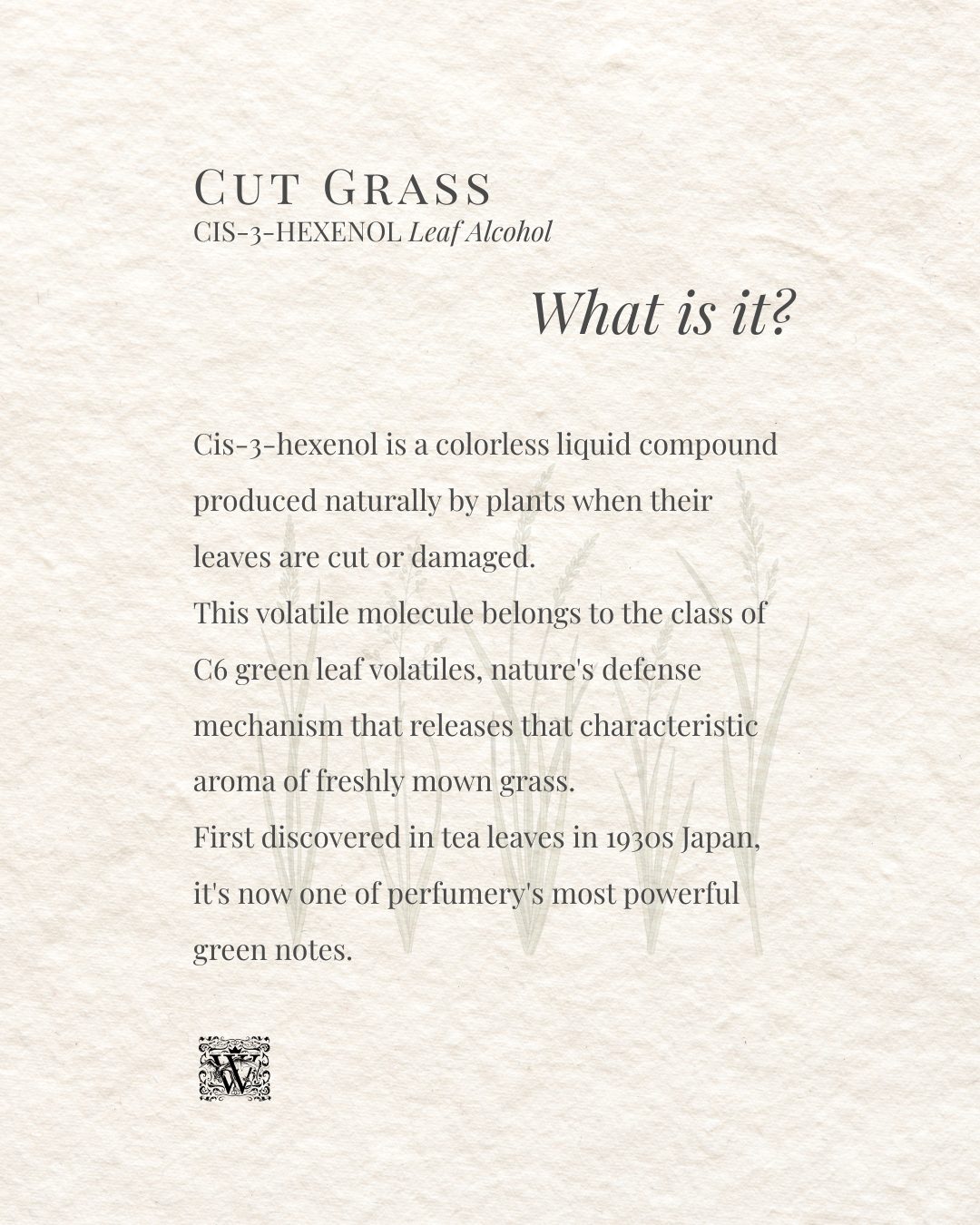


At a glance: Cis-3-Hexenol in Niche Perfumery
- A green leaf volatile produced naturally by plants when their leaves are cut or damaged, first identified in tea leaves in 1930s Japan and now one of perfumery’s most powerful green ingredients
- Smells intensely fresh and green: think freshly mown grass, crushed leaves, and a subtle sweet-herbaceous quality underneath
- Works as a top note, providing an immediate and vivid opening that brings genuine naturalistic lift to a composition
- Pairs beautifully with floral, fruity, and fresh accords; use with restraint as it is extraordinarily potent
- Derived from biotechnology rather than direct plant extraction, making it consistent in quality and 100% biodegradable; also widely used in the flavour industry
- Used by Louise in Country, where its honest, outdoorsy green character feels entirely at home
What is Cis-3-Hexenol?
Cis-3-hexenol is a colourless liquid compound produced naturally by plants when their leaves are cut or damaged. This volatile molecule belongs to a class known as C6 green leaf volatiles, nature’s defence mechanism that releases that characteristic aroma of freshly mown grass. First discovered in tea leaves in 1930s Japan, it’s now one of perfumery’s most powerful green notes.
Its chemical formula is C₆H₁₂O, with a molecular weight of 100.16 and a CAS number of 928-96-1. What makes it distinctively fresh rather than simply vegetal is its specific molecular configuration: it’s the ‘cis’ arrangement around the double bond that gives it that clean, lifting green character. Change that geometry, and you lose the magic entirely.
It’s worth noting that while cis-3-hexenol can be found in nature, the version used in perfumery today is derived from biotechnology, making it 100% biodegradable and consistent in quality. It’s also used extensively in the flavour industry, where that true-to-nature green note is just as valued.
How I Use Cis-3-Hexenol in Niche Perfumery
Prized for its intensely powerful character, cis-3-hexenol is unmistakable: fresh cut grass and crushed green leaves with subtle sweet-green and herbaceous nuances. This remarkable ingredient serves as an essential top note, bringing authentic natural greenness and brightness to floral, fruity, and fresh compositions, adding realism and lift that synthetic greens simply cannot match.
The key with cis-3-hexenol is restraint. It is extraordinarily potent, and a heavy hand will take a composition somewhere rather agricultural rather than elegantly green. Used with care, though, it brings an almost photorealistic quality to a fragrance. You smell it and you are there, outside, in the air.
I’ve used it in Country, where it does exactly what you’d hope: anchors the composition in something genuinely natural and outdoorsy. As soon as those first lawnmowers start up in spring, I think of this molecule.
Cis-3-Hexenol is Naturally Uplifting
Cis-3-hexenol evokes an immediate sense of freshness and connection to nature. Research suggests that green leaf scents may have stress-reducing and calming qualities, and the aroma often evokes positive associations with outdoor spaces, gardens, and the natural world. Many people find that fresh, grassy character genuinely uplifting, and I think there’s something in that. We are wired to respond to these signals from the plant world.
It’s one of those materials that, when you smell it on a blotter for the first time, makes people laugh with recognition. That’s exactly it, they say. That’s the smell. There’s real joy in a molecule that does that.
What Fragrance Family Does Cis-3-Hexenol Belong To?
Cis-3-hexenol sits firmly within the green family of fragrance notes, characterised by fresh, natural, and outdoor qualities. Within the broader structure of the fragrance wheel, it bridges the fresh and aromatic families beautifully, adding brightness and naturalistic lift to compositions across many different genres.
As a top note, it provides an opening impression that is immediate and vivid. It won’t linger as a base note would, but its impact in those first moments of wear is considerable. In the traditional perfume pyramid, it’s one of the notes that creates that vital first impression, before the heart of a fragrance reveals itself.
The Cis-3-Hexenol Difference
You may already know cis-3-hexenol as the scent that fills the air on a freshly mown lawn, even if you’ve never known its name. That’s the thing about perfumery materials: they’re all around us, embedded in the everyday, long before we learn to identify them.
In niche perfumery, we use it not to replicate a simple green note, but to bring genuine naturalistic truth to a composition. Commercial fragrances might gesture towards green, but working with cis-3-hexenol at this level, understanding its potency and its character, allows for something far more considered and specific.
It’s a molecule that rewards curiosity. Once you know it’s there, you’ll smell it everywhere: in the garden, in the countryside, in a beautifully made fragrance that feels alive rather than constructed.
Louise Smith
from my Perfumer’s Notebook
I regularly share material deep dives, lab notes, and the stories behind my fragrances over on Instagram. If you enjoyed getting to know cis-3-hexenol, there’s plenty more to explore about the materials I work with every day.
Come and follow along, I’d love to share more of the world behind the bottle.