- (€) EUR
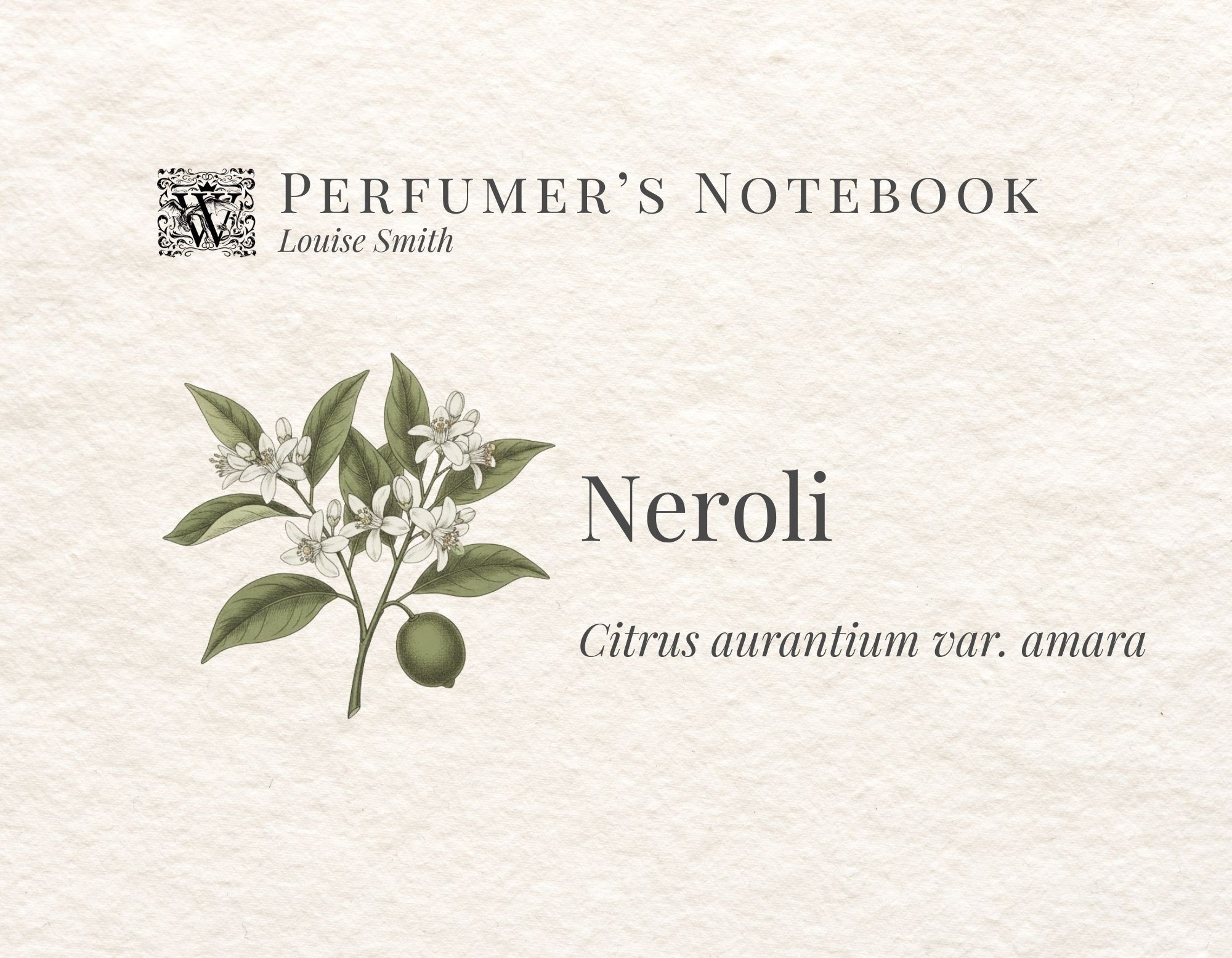
Neroli in niche perfumery: the extraordinary floral heart of bitter orange
There is a moment in the studio when I hold a scent strip freshly spritzed with neroli up to the light and just breathe. It never gets old.
Neroli in niche perfumery is one of those materials that stops people in their tracks. Sweet, yes, but not in a sugary way. Floral, but with a green, almost dewy quality underneath that keeps it feeling fresh and alive. And threaded through it, if you know to look for it, there is the faintest suggestion of honey. It is complex in the way that only truly beautiful natural ingredients can be, and it is deeply, irreversibly addictive to work with.
It comes from the flowers of the bitter orange tree, Citrus aurantium var. amara, and that lineage alone tells you something. When you think about how many blossoms must be gathered by hand, and how many kilos of flowers are needed to produce even a small amount of the essential oil, you begin to understand why neroli is so prized. It is not an ingredient that comes easily or cheaply. It is earned.
At a glance: Neroli in Niche Perfumery
- An essential oil steam-distilled from the hand-picked blossoms of the bitter orange tree, Citrus aurantium var. amara, and one of the most prized naturals in fine fragrance
- Produced from the flower only, quite distinct from petitgrain (leaves and twigs) and bitter orange peel; it takes a very large quantity of hand-picked blossoms to yield even a small amount of oil
- Smells sweet, floral, and luminously green, with a soft honeyed quality and a bright, sparkling citrus opening
- A top to heart note: provides initial freshness and brightness before settling into a rich, warm floral heart
- Exceptionally versatile, working beautifully in white floral, hesperidic, chypre, and cologne structures; particularly lovely alongside jasmine, rose, and white musks
- Grown primarily in Morocco, Tunisia, Egypt, and southern France; subject to harvest variation and high supply demands, making it a material to be used with care and intention
- Used by Louise in Country, where its honeyed, airy floral character felt entirely at home
What is Neroli?
Neroli is an essential oil steam-distilled from the freshly harvested blossoms of the bitter orange tree. It is quite different from petitgrain, which comes from the leaves and twigs of the same tree, and from bitter orange peel, which is cold-pressed from the fruit. Neroli is purely the flower, and that distinction matters enormously to its character.
The name is said to derive from Anne Marie Orsini, Princess of Nerola, who in the late seventeenth century is credited with popularising the use of bitter orange blossom oil to scent her gloves and bathwater. Whether or not that story is entirely accurate, it is the kind of detail that makes perfumery feel genuinely connected to history.
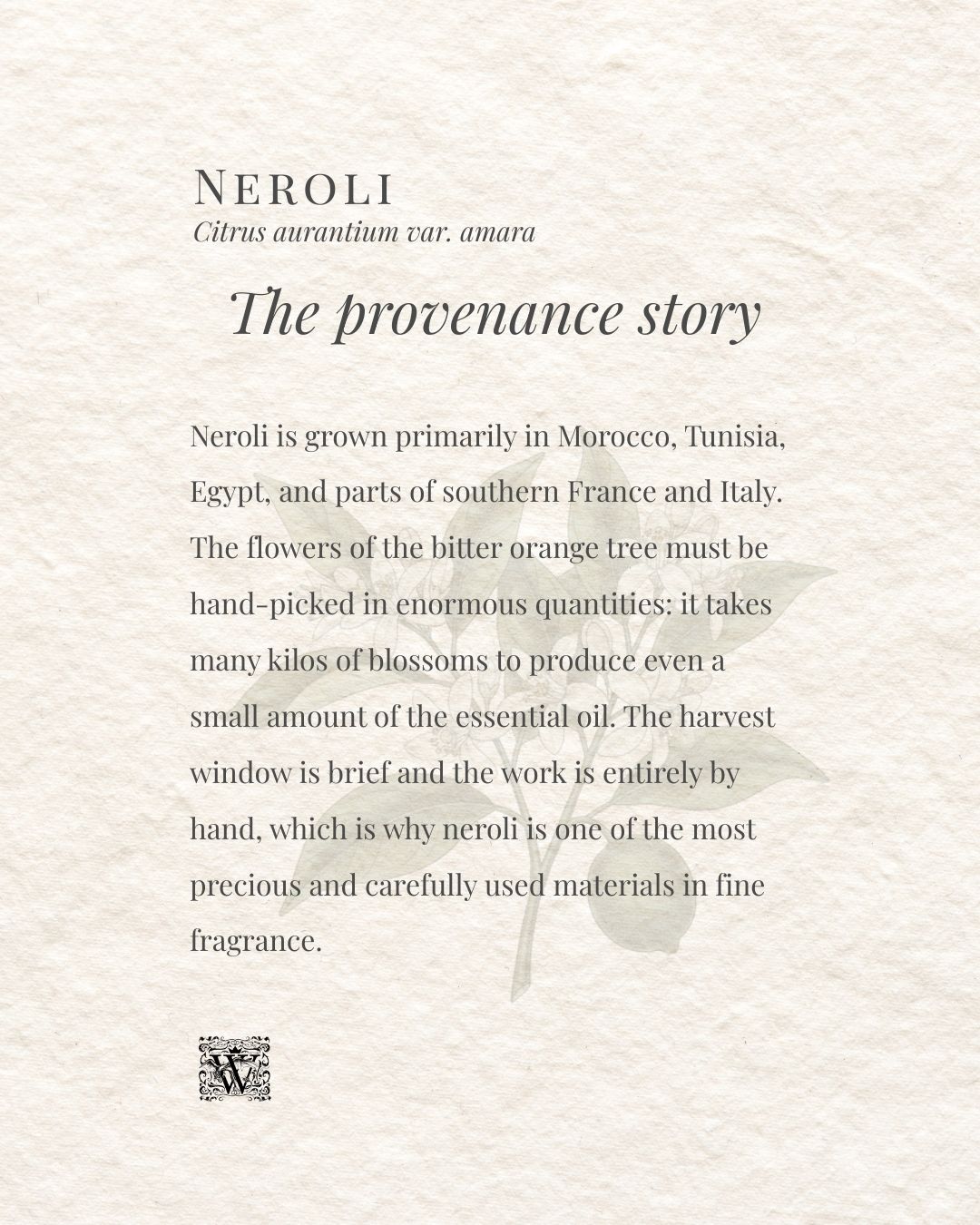
The primary growing regions for neroli include Morocco, Tunisia, Egypt, and parts of southern France and Italy. Moroccan and Tunisian neroli tend to be the most widely used in fine fragrance, each with their own subtle character. The harvest is a brief and labour-intensive window, which is part of why neroli carries such value.
How I Use Neroli in Niche Perfumery
Neroli is classically a top to heart note, meaning it plays a role in those first beautiful moments of a fragrance as well as contributing to the heart as it develops. Its natural tenacity is not particularly long-lasting on its own, which is why perfumers often work with it alongside fixatives and base materials that anchor and extend its character.
It is most at home in white floral compositions, where it brings freshness and a delicate honeyed quality without the heaviness that some white florals can carry. It works beautifully alongside jasmine, rose, and tuberose, adding a kind of luminosity that heavier florals can struggle to achieve alone. In hesperidic and cologne-style compositions it provides that characteristic citrus-floral brightness that feels clean and uplifting. And in chypre structures, neroli has a long and distinguished history as a key accord element.
I use neroli in Country, where its airy, honeyed floral character felt entirely at home. It is one of the notes that makes Country feel genuinely connected to the natural world it is named for.


Neroli: The Sustainability and Supply Story
Neroli in niche perfumery is sometimes called a high-impact natural: precious, difficult to produce at scale, and subject to variation between harvests. The labour involved in hand-picking the blossoms, often at very specific times of day to preserve their aromatic quality, means that it commands a significant price and is susceptible to supply pressures.
This is one of the reasons I am always careful about how I use it. A material with this kind of provenance deserves to be used intentionally, not as a filler or as an easy shortcut to brightness. When neroli is in one of my compositions, it is there because nothing else would do.
Louise Smith
from my Perfumer’s Notebook
I regularly share material deep dives, lab notes, and the stories behind my fragrances over on Instagram. If you enjoyed getting to know neroli, there’s plenty more to explore about the materials I work with every day.
Come and follow along, I’d love to share more of the world behind the bottle.