- (€) EUR
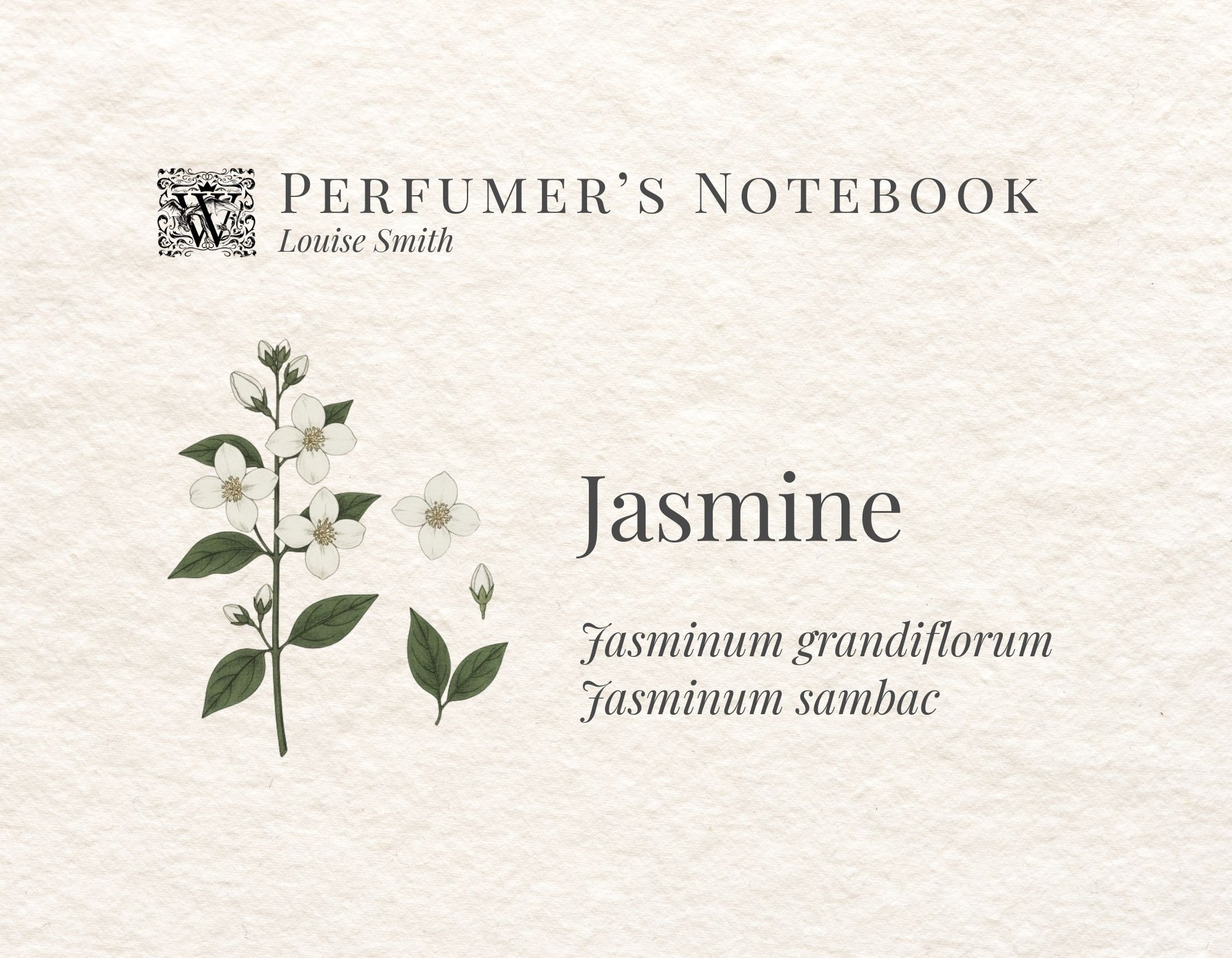
Jasmine in Niche Perfumery: The Perfumer’s Notebook
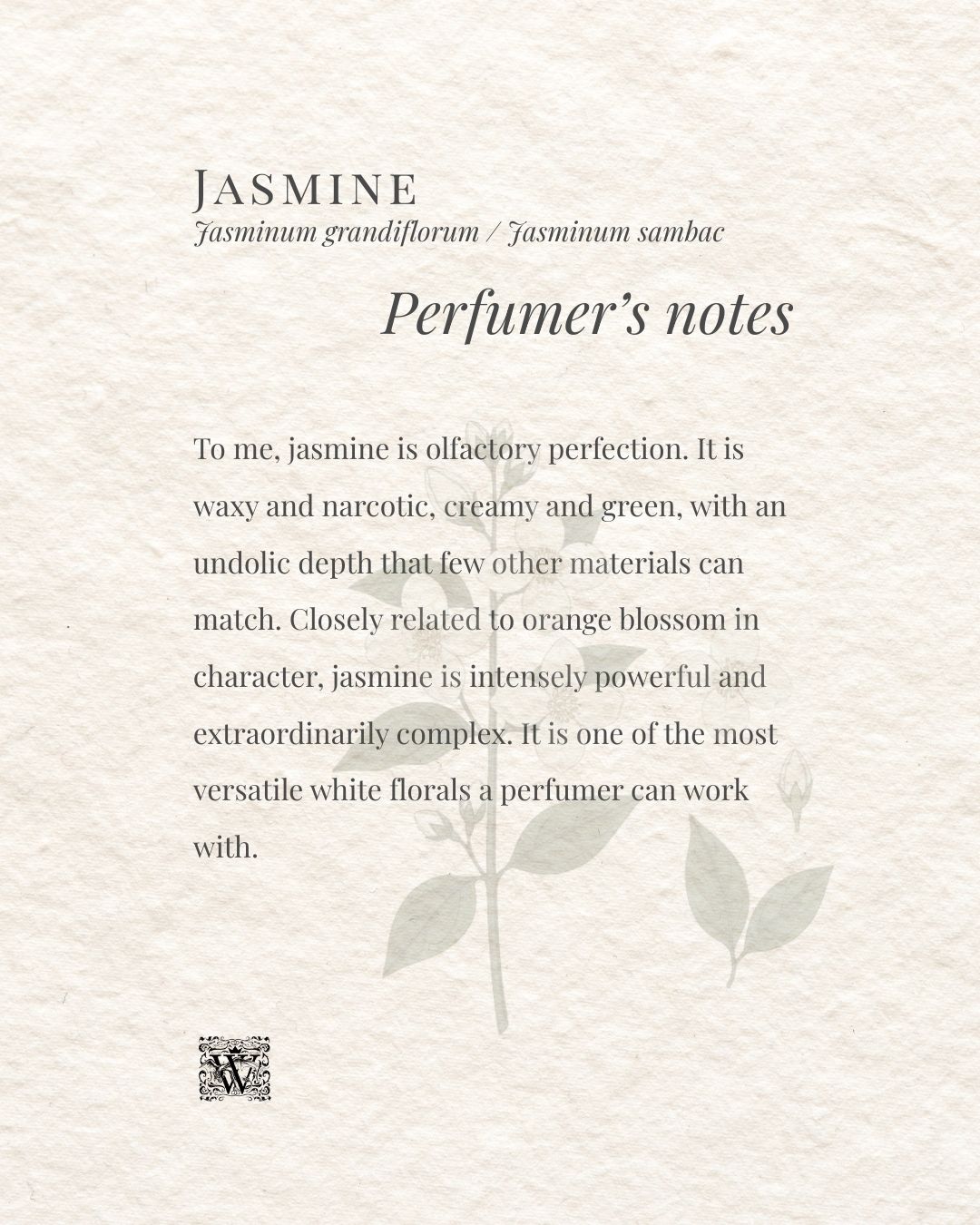
If I had to name a single material that comes closest to olfactory perfection, it would be jasmine. There is nothing quite like it. It is white floral in character, yes, but that barely scratches the surface of what jasmine actually is and what it does in a composition. It is waxy and narcotic, green and creamy, undolic and utterly complex. It can be the gentlest thing in the room, or it can fill a space completely. And it has been the beating heart of some of the greatest fragrances ever made.
Understanding jasmine properly is one of the most rewarding things you can do as a fragrance lover. So let me take you into it.
At a glance: Jasmine in Niche Perfumery
- One of the most prized and expensive raw materials in perfumery, valued for its extraordinary complexity and depth
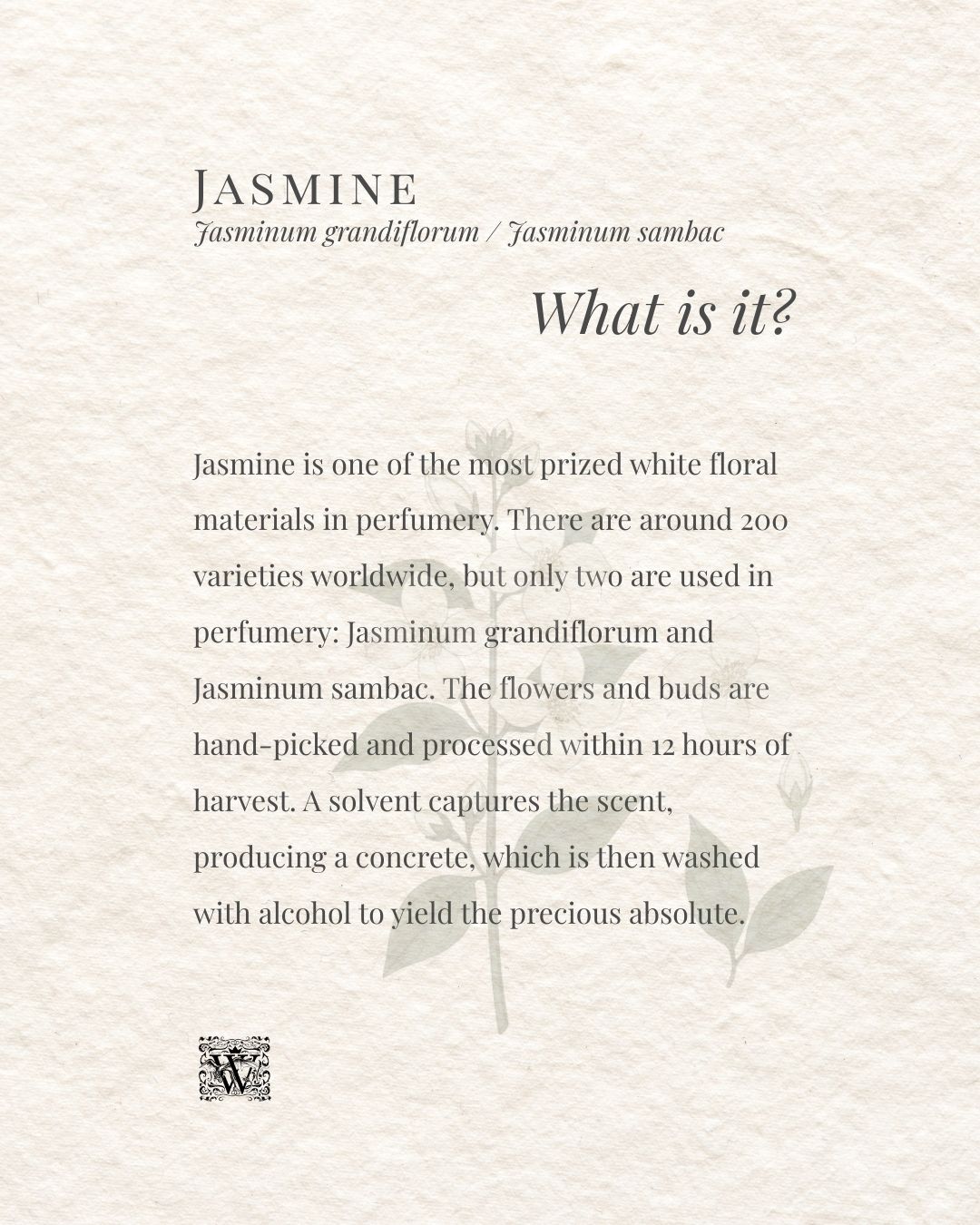
- There are around 200 varieties of jasmine worldwide, but only two are used in perfumery: Jasminum grandiflorum (Grasse jasmine) and Jasminum sambac (Arabian jasmine)
- The flowers and buds must be hand-picked and processed within 12 hours of harvest to preserve the fragrance Extracted using solvent extraction, producing a concrete which is then washed with alcohol to yield the jasmine absolute
- A white floral material with multiple facets: waxy, narcotic, creamy, green, and undolic
- Olfactorily connected to both orange blossom and green grass, making it unusually versatile for a material of such intensity
- Sits within the white floral and broader floral family on the fragrance wheel, bridging beautifully into oriental territory
- Most commonly used as a heart note, though its tenacity means it carries through into the base
- The finest jasmine absolute still comes from Grasse in the south of France, though India, Egypt, and Morocco are also significant producing regions
What is Jasmine?
Jasmine belongs to the white floral family, a group of intensely beautiful, often heady materials that includes orange blossom, tuberose, and gardenia. It is olfactorily connected to both orange blossom and green grass, and that combination of creamy warmth and green freshness is part of what makes it so endlessly versatile.
There are around 200 varieties of jasmine growing around the world, but only two are used in perfumery: Jasminum grandiflorum, the Spanish or Grasse jasmine, and Jasminum sambac, also known as Arabian jasmine. Each has its own distinct character. Grandiflorum is the classic, with that rich, warm, slightly indolic sweetness. Sambac is more heady and narcotic, with a creamier, almost milky quality.
The best jasmine in the world still comes from Grasse in the south of France, though India, Egypt, and Morocco are also important producing regions. It is one of the most labour-intensive raw materials in perfumery, and that is reflected in its price.
How Jasmine is Harvested and Processed?
This is where jasmine really begins to reveal how extraordinary it is. The flowers and buds must be harvested and processed within 12 hours of picking. That is not a preference; it is a requirement. Leave jasmine flowers any longer and the fragrance begins to deteriorate. The whole operation is a race against time.
Harvesting is done entirely by hand, in the early hours of the morning when the blooms are at their most fragrant. Each flower is picked individually. It is painstaking, slow work, and it takes enormous quantities of flowers to produce even a small amount of the finished material. A single kilogram of jasmine absolute requires millions of flowers.
Once harvested, the flowers are processed using solvent extraction. The solvent captures the scent from the flowers, producing what is called a concrete: a waxy, semi-solid substance that contains the aromatic compounds. The concrete is then washed with alcohol, which dissolves the fragrant elements and separates them from the wax. What remains once the alcohol is removed is the jasmine absolute: a rich, deep, intensely concentrated material.
This process is why jasmine absolute is one of the most expensive materials a perfumer can work with. You are paying for an enormous quantity of hand-picked flowers, processed against the clock, using a method that preserves every nuance of the original scent.
How I Use Jasmine in Niche Perfumery
Jasmine is not a shy material. Even in small quantities it asserts itself, and learning how to work with it, rather than around it, is one of the great skills of perfumery. I have always loved the challenge of it.
What fascinates me most is the range of facets jasmine can express depending on how it is used and what surrounds it. In a composition that leans into its waxy, indolic qualities, jasmine becomes almost animalic in the best possible way: warm skin, warm blooms, something a little dangerous. Pair it with green materials and it becomes lighter, almost dewy. Bring in creamy musks and it transforms into something luxuriously smooth.
In niche perfumery, we have the freedom to use jasmine in ways that commercial fragrance rarely allows. We can let it be narcotic and powerful without softening it for mass appeal. We can explore its green facets, its creamy facets, its indolic depth. That is one of the reasons jasmine sits at the heart of so many significant niche compositions: it rewards that kind of attention.
What Fragrance Family is Jasmine in?
Jasmine sits firmly within the floral family, and more specifically within the white floral sub-family. White florals are distinguished from other florals by their intensity, their richness, and that characteristic combination of sweetness with an undolic, slightly animalic edge.
On the fragrance wheel, jasmine bridges the floral and oriental families beautifully. Its warmth and depth allow it to anchor richer, more opulent compositions, while its brightness and green facets mean it can just as easily lift a fresher scent. That is genuinely unusual for a floral material of such intensity.
In terms of the perfume pyramid, jasmine is most often used as a heart note, the emotional core of a composition, though it has the persistence and depth to carry through into the base as well.
Why Jasmine is So Expensive?
This is the question I am asked most often, and I am always glad when people ask it. Jasmine absolute is expensive because nothing about its production is easy or efficient.
The flowers must be hand-picked at the right moment, processed within hours, and extracted using a method that is thorough but gentle enough to preserve the full complexity of the scent. There is no shortcut that does not cost something in quality. The finest jasmine absolute, from Grasse in particular, is genuinely one of the most precious raw materials on earth.
This is why so many commercial fragrances rely on synthetic jasmine molecules rather than the absolute. Those synthetics, materials like hedione and dihydrojasmone, can do a great deal and have their own interesting qualities. But they do not replicate the full experience of real jasmine absolute. In niche perfumery, we use the real thing, and the difference is palpable.
The Jasmine Difference
Every time I work with jasmine absolute, I am reminded of why it has been at the centre of perfumery for centuries. There is an aliveness to it, a complexity that unfolds slowly and keeps surprising you. It is not a material you exhaust.
Whether you encounter it as the dominant note in a grand white floral, a soft creamy warmth in the heart of something quieter, or a green shimmer beneath a citrus opening, jasmine is doing something specific and irreplaceable in every composition it appears in.
To understand jasmine is to understand something essential about what niche perfumery is for. This is a material that demands to be used with care, with respect, and with a genuine appreciation of where it comes from and what it took to produce it. When you smell it, you are smelling the work of countless pairs of hands, the early morning air of a jasmine field, and hundreds of years of perfumers who felt exactly the same way I do about it.
To me, it is perfection.
Louise Smith
from my Perfumer’s Notebook
I regularly share insights from my perfumer’s notebook on Instagram. Behind-the-scenes glimpses from the lab, ingredient deep dives, and the stories behind our fragrances. If you enjoyed getting to know jasmine, there is plenty more to explore about the materials I work with every day.
Come and follow along as I continue exploring the art and science of perfumery. I’d love to connect with you there and hear about your own fragrance discoveries.